HAPPY 92ND BIRTHDAY BILL WHITE!!

Bill White celebrates his 92nd birthday on January 28th. He is one of 5 surviving members of the New York Giants. Bill played for the franchise both in New York and San Francisco. Many New Yorkers know him as one of the voices on Yankee Baseball. He would later become President of the National League and did so much in the game and for the game. Here is a list of the remaining living members of the NY Giants, with their birth dates starting with January. After that is a nice article written a few years back on Bill.

■Joe Margoneri 1956-57 B: 1/13/1930 P

■Joey Amalfitano 1954-55 B:1/23/1934 INF

■Bill White 1956 B: 1/28/1934 1B

■Al Worthington 1953-54, 1956-57 B: 2/5/1929 P

■Jackie Brandt 1956 B: 4/28/1934 OF

TIDBITS:

-Joey Amalfitano and Al Worthington are the only remaining NY Giants from the 1954 World Championship team, the last WS Championship they won in NY.

-Joe Margoneri is the only NY Giant of the 5 remaining NY Giants to solely play for the franchise in NY and not in San Francisco.

-Jackie Brandt, Bill White, and Al Worthington, are the only remaining Giants who played for the team in NY and

were members of the inaugural SF Giants in 1958.

-Joey Amalfitano is the only NY Giant who played with the SF Giants, but not during the inaugural 1958 season in San Francisco.

-Jackie Brandt (91) is the youngest living NY Giant and Al Worthington (96) is the oldest living NY Giant.

https://www.cooperstowncred.com/the-hall-of-fame-case…

Sometimes in the history of baseball, there are men who had a longstanding impact and relevance in the game but didn’t quite measure up to the standards of a Hall of Famer in any aspect of their baseball life. Bill White is one of those men. He was an excellent first baseman (a 7-time Gold Glover) who hit .286 in his 13-year Major League Baseball career. Then, for 18 years, he was a pioneering broadcaster, the first African-American to be a full-time announcer for an MLB team. From 1971-88, he partnered with Phil Rizzuto and Frank Messer in the TV and radio booths for the New York Yankees.

White’s baseball career ended with a six-year assignment as the president of the National League, from 1989-94, making him the first black executive in any major sport.

White may not have had the longevity as either a player, broadcaster, or executive to merit a plaque in Cooperstown but, when you look at the totality of his baseball life, he becomes a compelling candidate.

Cooperstown Cred: Bill White (1B)

• New York/San Francisco Giants (1956 & ’58), St. Louis Cardinals (1959-65 & ’69), Philadelphia Phillies (1966-68)

• Career: .286 BA, .351 OBP, .455 SLG, 1,706 Hits, 202 HR, 870 RBI

• Career: 117 OPS+, 38.6 WAR (Wins Above Replacement)

• 8-time All-Star in 5 different seasons (two games per year played from 1959-62)

• 7-time Gold Glove winner

• Member of 1964 World Series Champion St. Louis Cardinals

• 18-year broadcaster (1971-88) for the New York Yankees

• President of the National League from 1989-94

Bill White: Early Years

William DeKova White was born on January 28, 1934, in Lakewood, Florida, a small town in the panhandle right on the Alabama border. White never knew his father and was raised by his mother and grandmother. The family moved to Warren, Ohio (near Youngstown) when Bill was three years old and lived in a segregated housing project.

White played football, basketball, and baseball at Warren G. Harding High School but wasn’t a big star in any sport. He went to nearby Hiram College on a football scholarship, choosing Hiram because of its pre-med program. White’s life changed when a scout for the New York Giants spotted him swatting two home runs in an amateur tournament in Cincinnati. He worked out for Giants manager Leo Durocher in Pittsburgh while the team was in town to play the Pirates and he was offered a contract. White’s plan was to pursue a medical degree if he didn’t reach the majors in three to four years.

White encountered some racism in Ohio, but it was nothing like what he endured in his early years in the minor leagues. In 1953, playing for Danville (Virginia) in the Carolina League, he was called “nig—” to his face for the first time, and called that season “the worst time of his life.”

In his 2011 memoir “Uppity: My Untold Story About The Games People Play”, he recounted one fan shouting, ‘You’ll be lucky if your black a– makes it out of here alive.’ White only exacerbated the situation by giving the fans the middle finger. His teammates escorted him to the bus, which the mob pelted with rocks.

— Jay Jaffe (FanGraphs Hall of Fame profile for Bill White), November 16, 2023

A powerful left-handed hitter, White hit well at every level of the minor leagues, progressing from Danville to Sioux City, Iowa, Dallas, and Minneapolis, before being promoted to the Giants in May 1956 at the age of 22. White, batting 6th in a lineup that featured Willie Mays as the team’s cleanup hitter, hit a solo home run in his first MLB at bat, leading off the 2nd inning.

These were no longer Durocher’s Giants, a team that had won the 1954 World Series. The 1956 edition, managed by Bill Rigney, only won 67 games, with White quickly establishing himself as one of the team’s best players. In his rookie campaign as the Giants’ starting first basemen, he hit .256 with 22 HR and 59 RBI, with the last two home runs coming in the season’s final game, against future Hall of Famer Robin Roberts. Despite the late start to the season, he quickly established himself as a top defensive first sacker, leading the N.L. in putouts and assists.

White’s MLB career went on hiatus when he was drafted into the Army in 1958. He missed all of 1957 and most of 1958, returning to the Giants (now in San Francisco) in late July. Upon his return, White was merely a pinch-hitter, since future Hall of Famer Orlando Cepeda had taken over at first base and was in the middle of a Rookie of the Year season. He was traded in March 1959 to the St. Louis Cardinals, a deal that changed his baseball life forever.

Bill White: Cardinals Years (1959-65)

Bill White was blocked at first base with the Giants by Cepeda and, with the St. Louis Cardinals, he was also blocked at first, by future Hall of Famer Stan Musial, now 38 and no longer playing the outfield. Wanting White’s bat in the lineup, manager Solly Hemus moved him to left field and he had a solid season, hitting .302 with 12 HR and 72 RBI. White, now 25, was twice elected to the All-Star Game (two games per year were played from 1959 to ’62) but did not appear in either game.

White wasn’t much of a left fielder defensively so, in 1960, Hemus moved him back to first base, with Musial mostly playing left in a less-than-full-time role. White flourished, winning the first of seven consecutive Gold Gloves. He hadn’t yet blossomed offensively (.283, 16 HR, 79 RBI) but, combined with his defense, was good enough to be elected to the All-Star Game twice again.

White was an All-Star twice again in 1961, this time voted as the starter for the N.L. squads. He went 3 for 7 in the two games with an RBI each. For the year he hit .286 with 20 HR and 90 RBI.

White blossomed offensively in 1962, hitting .324 with 20 HR and 102 RBI. Ironically, he didn’t make either All-Star Game that year, blocked by Cepeda and Ernie Banks, who had moved from shortstop to first base.

In 1963, White continued his offensive prowess, hitting .304 with 27 HR, 109 RBI, 106 Runs, and 200 Hits. He was an All-Star once again (as the starting first baseman) and finished 7th in the MVP vote. The Redbirds, now skippered by Johnny Keane, won 93 games, putting them just 6 games shy of the N.L. pennant.

1964 was a magical season for the Cardinals. Lou Brock was in the fold in left field, third baseman Ken Boyer had an MVP season, and Bob Gibson led a strong starting rotation with three 18-game winners. Although the Redbirds won the same number of games (93) as they had in 1963, this year it was good enough to win the pennant; the Cards edged the Cincinnati Reds and Philadelphia Phillies by a single game. For his part, White continued to hit like an All-Star, hitting .303 with 21 HR and 102 RBI, his third consecutive season with 100 RBI or more. It was good enough to place him 3rd in the N.L. MVP vote, behind Boyer and Philadelphia’s Johnny Callison.

The 1964 Phillies famously lost 10 games in a row in late September, blowing a 6.5-game lead. The Cardinals were the beneficiaries, with White a key contributor to the Redbirds’ strong finish. He hit .429 (1.268 OPS) with 4 HR and 16 RBI in the Cards’ final 12 games, 9 of which were victories.

White’s bat went quiet in the World Series against the New York Yankees (he went 3-for-27 with a pair of RBI) but his teammates pulled out a 7-game series victory in what would be White’s only postseason appearance.

Keane left the Cardinals to take over the Yankees in 1965; his replacement was White’s former teammate Red Schoendienst. It was a disappointing season for the defending World Series champs with the team winning just 80 contests. White continued his strong play, hitting .289 with 24 HR albeit with a lackluster 73 RBI.

Bill White’s Final Years (1966-69)

After the disappointing 1965 campaign, General Manager Bob Howsam decided to clean house, trading away White, Boyer, and second baseman Dick Groat. White, Groat, and backup catcher Bob Uecker were dealt to the Philadelphia Phillies in exchange for Pat Corrales, Alex Johnson, and Art Mahaffey.

Playing for manager Gene Mauch, the 32-year-old White had another strong campaign, hitting .276 with 22 HR and 103 RBI. He won his 7th and final Gold Glove, while the Phillies finished 4th in the N.L. with 87 wins. It was White’s final campaign as a premier player.

In December 1966, White tore his right Achilles tendon while playing paddleball. He tried to come back too soon and had several setbacks. Even with the help of Novocain and amphetamines, White was only able to play 110 games, with 369 plate appearances. He hit just .250 with only 8 HR and 33 RBI.

It didn’t get any better for White in 1968; he hit .239 with 9 HR and 40 RBI in 431 plate appearances. He was traded back to the Cardinals in the spring of 1969. White was used almost exclusively as a pinch-hitter, hitting .211 with 0 HR and 4 RBI in a mere 68 PA. He retired at the end of the season with a career .286 average along with 202 HR and 870 RBI.

In his 13 years on the diamond, White counted 13 future Hall of Famers as his teammates:

• Giants: Willie Mays, Hoyt Wilhelm, Red Schoendienst (also with the Cardinals), and Orlando Cepeda.

• Cardinals: Stan Musial, Bob Gibson, Minnie Minoso, Lou Brock, Steve Carlton, Ted Simmons, and Joe Torre (elected as a manager).

• Phillies: Jim Bunning and Fergie Jenkins.

“You can trust him with your life — if he likes you. And if he doesn’t, I don’t think you’d go away wondering about it.”

— Bob Gibson (reported in the New York Times Magazine), October 13, 1991

Bill White and the Integration of Major League Baseball

Bill White wasn’t a pioneer for the integration of African-American players into Major League Baseball (he debuted 9 years after Jackie Robinson crossed the color line) but he was a leader in speaking up about the lack of equal treatment blacks received as professional baseball players.

During his time in the Army, White showed that he wasn’t the kind of man to quietly accept the inherent discrimination in America. White serving at Fort Knox, Kentucky, he quit the Army baseball team when his teammates’ seemed uncaring when he was refused service in a restaurant.

In the majors, White’s career started in a good place, with the Giants on a team in New York City that had an established black superstar (Willie Mays). The same cannot be said for when he joined the St. Louis Cardinals in 1959. The Cardinals were the last MLB team to integrate seating at their ballpark and the best black player on the team (center fielder Curt Flood) was a second-year player, hardly an established star. Bob Gibson had yet to appear in the majors and didn’t emerge as a regular starter until 1961.

It was in 1961, with Florida’s spring training sites still segregated, White spoke up.

“In St. Petersburg the Cardinals’ black players stayed with local families. The pioneering black sportswriter Wendell Smith had raised the issue and a few major newspapers took up the story. That spring the St. Petersburg Chamber of Commerce invited only white players to its annual “Salute to Baseball” breakfast. White complained to a reporter, “When will we be made to feel like humans?” He was one of the few black players¬—if not the only one—to speak up publicly.

By the next spring a St. Petersburg businessman had bought two motels and made them available to the team. Stars including Musial and Ken Boyer, who usually stayed with their families in rented beach houses, moved into the motels in a show of solidarity. Several players manned grills at dinnertime and White’s wife, Mildred, conducted classes for the children. Locals would drive by to watch black and white families frolicking together in the pool, a sight unprecedented in the Deep South.”

— Warren Corbett (from his SABR bio about Bill White)

By the beginning of spring training in 1962, half of the 14 teams training in Florida had integrated their facilities, the rest would do so by the end of that spring or the next year.

Bill White’s Broadcasting Career

While playing with the Cardinals and the Phillies, Bill White started his career on the airwaves, working in both radio and television. He worked part-time for KMOX radio in St. Louis, hosted a pregame radio show in Philadelphia, and worked in the offseasons as a sports reporter for local TV. After his playing days, he called college basketball and even hockey, becoming the first black broadcaster to call an NHL game.

Thanks in part to the recommendation of Howard Cosell, who had heard White calling college basketball, he was hired to join the broadcast booth for the New York Yankees in 1971. Along with former Yankees’ great Phil Rizzuto and longtime broadcaster Frank Messer, White was one of the voices on both radio and TV that brought Yankees games to life in the 1970s and 80s.

I grew up in New York City as both a Boston Red Sox and New York Mets fan (weird, I know, a story for another day). Anyway, as a New Yorker, the only times I could watch the Red Sox was when they played the Yankees or were on national television. And, thus, I grew up with White, Rizzuto, and Messer as much as I grew up with the Mets’ legendary broadcast trio of Lindsey Nelson, Bob Murphy, and Ralph Kiner.

Rizzuto, the beloved “Scooter” who was a part of seven World Series champion Yankees teams in the 1950s and ’60s, was the comic relief in the booth, with White and Messer playing the straight men. Rizzuto could get away with things that most announcers could not. He would famously leave the booth in the 7th inning so he could beat the traffic to New Jersey on the George Washington Bridge, he coined the phrase “WW” (wasn’t watching) when he missed a play during the game and had to put something in his scorebook. And, of course, he was always wishing friends Happy Birthday and plugging his favorite Italian restaurants.

All three men shared play-by-play duties on both TV and radio, with White happening to be calling the TV action during one of the most famous plays in the 1970s for the Bronx Bombers, Bucky Dent‘s home run over the Green Monster in the one-game playoff with the Red Sox in 1978.

White also was hired by CBS Radio and ABC Sports to do national work, where he also was a part of the Winter Olympics Coverage in 1980 and ’84. White called five World Series on CBS Radio (1976-78, 1987-88) and presented the World Series trophy on ABC when the Yankees won it in 1977.

White’s final season as a broadcaster was in 1988 and he finished his career as an on-air participant for one of the greatest moments in baseball history.

Bill White: National League President

Although his entire career in baseball will be considered, Bill White is currently on the Hall of Fame ballot for his role as the president of the National League, not for his years on the diamond or in the booth.

White had the opportunity to be an executive pioneer with the Yankees; he had twice turned down owner George Steinbrenner to be the Yankees General Manager. White had closely observed how tough it was for a manager or GM to work for The Boss and declined the offers.

In 1988, N.L. President Bart Giamatti became the Commissioner of baseball, creating an executive opening in the senior circuit. And, so in 1989, White became the N.L. president, having been recruited by Los Angeles Dodgers president Peter O’Malley. After initial reluctance, White decided that he had to take the job. He became the highest-ranking black executive in any sport.

In the fall of 1988, Hall of Famer Hank Aaron publicly bemoaned the lack of African-American representation in management positions in Major League Baseball, in both the dugout and the executive suite. Aaron himself had become the VP of player development for the Atlanta Braves in 1982 and a few former black players (notably Frank Robinson) had been hired as managers.

“You can say that Jackie Robinson is resting a little more comfortably in his grave now, because he went through hell. If it weren’t for him, there would not have been a Hank Aaron, or a Larry Doby (who broke the color barrier in the American League in 1948), or a Bill White. Baseball has moved into another dimension.”

— Hank Aaron (February 8, 1989)

As the league president, White was mostly responsible for discipline for players, coaches, and managers and for supervising N.L. umpires. White had a cool relationship with the umpires’ union chief, Richie Phillips, who felt that the former player reflectively took the player’s side when in dispute with an ump. White admitted as much to the New York Times’s Claire Smith: “Hey, I can’t help it, I’m still a player. I’ll always be a player.”

White considered his most important accomplishment was how he helped guide the N.L.’s expansion process that led to new franchises in Miami and Denver in 1993, although he was disappointed when the Colorado Rockies did not interview minority candidates for front-office jobs (this was a mandate put in place by Giamatti in 1989 and endorsed by commissioner Fay Vincent).

White was criticized for being inaccessible to the media, save a few reporters (such as Smith) who knew him during his playing days. “I don’t talk to the man, I don’t even try anymore,” said veteran writer Jerome Holtzman. “Why keep trying if the man won’t acknowledge you?”

(White) became frustrated by the seeming impossibility of satisfying so many constituencies — labor and management, players and umpires. “There are just too many spheres of influence all working against each other instead of working to where you get one circle together,” he told Smith. In a 1992 speech to the Black Coaches Association, he voiced some frustration at the owners by saying, “I deal with people now who I know are racists and bigots. I’m bitter. I’m mad.”

— Jay Jaffe (FanGraphs profile of White), November 16, 2023

White retired from his job as N.L. president in 1994, sensing the end of the independent executives in Major Baseball due to the owners’ ouster of Commissioner Vincent, replacing them with “one of their own” (Bud Selig). White turned out to be right; the leagues ceased functioning as separate entities in 2000; his successor Leonard Coleman was the last N.L. president.

Bill White and the Hall of Fame

Bill White appeared on three BBWAA (Baseball Writers Association of America) ballots, from 1975-77, earning at most 1.9% of the vote in an election that requires 75% for enshrinement into Cooperstown. Prior to his presence on this year’s ballot, he has appeared on a version of the Veterans Committee ballot three times before, never coming close to induction.

Although not a Hall of Famer ,White has been influential in the administration of the Hall, having spent many years on the Hall’s Board of Directors. In 1991, he was an “affirmative” vote in the Board’s unanimous decision to keep Pete Rose off the BBWAA Hall of Fame ballot by adopting a rule indicating that anyone on baseball’s ineligible list “shall not be an eligible candidate to the Baseball Hall of Fame.”

He also was a voting member of several Veterans Committees that considered the candidacies of players overlooked on the writers’ ballot and for non-players. He was no doubt an instrumental “yes” vote in the election of Rizzuto to the Hall of Fame in 1994.

HAPPY 92ND BIRTHDAY JOEY AMALFITANO!!

Joey Amalfitano celebrates his 92nd birthday on January 23rd. He is one of 5 surviving members of the New York Giants. Below is a list of the remaining living members of the NY Giants, with their birthdates starting with January. After that is an old article on Amalfitano.

■Joe Margoneri 1956-57 B: 1/13/1930 P

■Joey Amalfitano 1954-55 B:1/23/1934 INF

■Bill White 1956 B: 1/28/1934 1B

■Al Worthington 1953-54, 1956-57 B: 2/5/1929 P

■Jackie Brandt 1956 B: 4/28/1934 OF

TIDBITS:

-Joey Amalfitano and Al Worthington are the only remaining NY Giants from the 1954 World Championship team, the last WS Championship they won in NY.

-Joe Margoneri is the only NY Giant of the 5 remaining NY Giants to solely play for the franchise in NY and not in San Francisco.

-Jackie Brandt, Bill White, and Al Worthington, are the only remaining Giants who played for the team in NY and were members of the inaugural SF Giants in 1958.

-Joey Amalfitano is the only NY Giant who played with the SF Giants, but not during the inaugural 1958 season in San Francisco.

-Jackie Brandt (91) is the youngest living NY Giant and Al Worthington (96) is the oldest living NY Giant.

As told to Ed Attanasio, This Great Game

Joey Amalfitano is a former utility infielder, manager and coach who played a combined 10 seasons with the New York/San Francisco Giants (1954-1955, 1960-1961 and 1963), Houston Colt .45s (1962) and Chicago Cubs (1964-1967). He managed the Cubs from 1979-1981 and is best known as the Los Angeles Dodgers’ third base coach for sixteen years from 1983-1998, which included a World Series championship (in 1988).

On his Early Days:

“When I was around ten years old, we had a very good softball team in grammar school. It was fast pitch softball and we played all over Southern California. We were going to play St. John Bosco one day. That was before the freeway was there, to give you an idea of how long ago that was. We went there thinking we were going to play softball, and all of a sudden we saw that they were playing baseball, something we had never done. Our parents had taken us all this way, so we decided to play and man—I liked it. I hit two home runs that day. We were playing in a huge field, so the ball just kept rolling. When I hit the ball, the bat sounded great and the ball went further. Right there, I got hooked. I do remember that and the sensation I got from it.”

On Joe DiMaggio:

“I was told that Joe liked me, at least that’s what I was told. So, then I got the ground rules, which I won’t share with you, okay? I was basically told how to act in his presence. You know, I stuck to the rules. I did the right thing and showed him respect and that’s why I was able to break bread with the man many, many times. Joe was always nice to me and I never saw him being sullen or rude to people, like some people have said. He was a complete gentleman, but he had ground rules.”

On the Bonus Baby Rule:

“I was on the Giants and not in the minors where I should have been, because I signed a deal for more than $6,000, which meant I had to be on the team’s 25-man roster. That was a big deal at the time, but it’s tip money for these players today. So, I basically sat on the bench and watched the games in ’54 and ’55. Seeing Leo Durocher in action I learned a lot about the game, but he was saddled with me, because I couldn’t play, at least at that level. I was essentially a spectator in a uniform. The team had two bonus babies in 1954: Myself and Paul Giel, a fella who was also a college football star who actually finished second in the Heisman trophy voting one year. So, Leo had 23 players essentially, because Paul and I couldn’t be relied on to do anything. We had no business being there at all, but can you imagine how a manager would do today with only 23 guys? I’m sure he wouldn’t like it, but Durocher never complained and all he did was win.”

On Leo Durocher:

“It was sad, because he made it into the Hall of Fame, but he wasn’t alive to enjoy it. I remember we discussed it one day, we were very close. One year, it looked like Leo was going to get elected and he didn’t make it. So, Peter O’Malley, the owner of the Dodgers, contacted me and asked me to call him and invite him to Vero Beach for spring training as his guest. But, after the disappointment of not getting into the Hall, Leo was really down and he said I don’t feel like doing it, but please thank Peter O’Malley for me, which I did. Leo said, ‘I know I’m going to get in, but I just hope it happens while I’m alive.’ But, it didn’t happen. (Durocher died in 1991 and was elected into Cooperstown in 1994.) He was tough on me and everyone else, but especially tough on me for some reason. He teased me constantly, but I think he was doing it to toughen me up. I was young, hell—I didn’t know what was going on. He would love to blast fungo shots at me all the time and he’d laugh when they bounced off my shins. I played very little for him, but I coached with him for many years. He taught me everything I know about the game. He was a great bench jockey and watching his mind work was amazing. If he yelled at a player, it was because he respected the guy; that was his way of doing it. Sometimes he would get very aggressive with the things he said, especially during the biggest games, when he was trying to rattle the other team.”

On Willie Mays:

“The first time I met him, he walked up and put his arms around me and said, ‘This is the kid who got all the money!’ referring to my bonus. And then he laughed his great laugh. He was a happy man and he loved playing. I never heard him complain or say anything bad about anybody. He was only three years older than me and we would drive together over to Ebbetts Field when we played in Brooklyn. He was an incredible player and he would do spectacular things all the time, to the point where it was almost expected.”

On the 1954 World Series:

“We were confident, so when we swept the Indians it wasn’t a big surprise. We played them a few times during spring training that year and beat them pretty handily, as I recall. So, we had a team meeting the night before the series and Durocher started reading from this scouting report and going through their lineup. After about the third name, he stopped and said, “We beat these guys in the spring and we’ll beat them again’ and that was the end of the meeting. He took that scouting report and threw it in the trash. My good friend Johnny Antonelli was unhittable in that series. He got a win and a save and we got some timely hitting and that’s how you win.”

On Bunting as a Lost Art:

“I teach these kids how to bunt, because they don’t know how to do it right. Teams just don’t bunt anymore, because everyone is trying to smack the ball out of the yard. The hit-and-run, sacrifice, double steal, suicide bunt—teams used to do that more. Leo Durocher taught me how to use all the tools and strategy you possibly can to get an advantage over your opponent and bunting is one way to do it. On any team, everyone should know how to bunt. Even your power hitters, because you never know, you never know.”

RAY CRONE PASSES AWAY

Former New York Giants pitcher Ray Crone passed away on January 15 at the age of 94, in Waxahachie, Texas. Crone, a right-handed pitcher, played for the Milwaukee Braves, and New York Giants (1957), and the San Francisco Giants in 1958. Crone’s passing leaves only 5 Giants who played for the team in New York. Those being:

■Joe Margoneri 1956-57 B: 1/13/1930 P

■Joey Amalfitano 1954-55 B:1/23/1934 INF

■Bill White 1956 B: 1/28/1934 1B

■Al Worthington 1953-54, 1956-57 B: 2/5/1929 P

■Jackie Brandt 1956 B: 4/28/1934 OF

MAY HE REST IN PEACE

Raymond Hayes Crone, a former Major League pitcher and longtime professional scout whose baseball career spanned more than half a century, passed away on January 15, 2026, in Waxahachie, Texas. He was 94. Born on August 7, 1931, in Memphis, Tennessee, Crone devoted his life to the game he loved, leaving a lasting imprint on the sport through both his playing days and his decades of talent evaluation.

Crone’s baseball journey began early. After starring at Christian Brothers High School in Memphis, he signed with the Boston Braves organization at just 17 years old. He quickly distinguished himself as a promising young pitcher, winning 19 games for the Jacksonville Braves in 1953 as the franchise transitioned to Milwaukee.

He made his major league debut with the Milwaukee Braves on April 13, 1954, and over the next five seasons established himself as a steady right‑handed presence on the mound. Crone pitched for the Braves through 1957 before being traded to the New York Giants in a deal that sent Hall of Famer Red Schoendienst to Milwaukee. He remained with the Giants through their move to San Francisco, appearing in his final major league game in 1958. He finished his MLB career with a 30–30 record, a 3.87 ERA, and 260 strikeouts across 137 games.

After retiring from pitching in 1961, Crone stepped away from the field but not from the sport. A decade later, he began a long and respected career as a scout, working for several organizations including the Montreal Expos, Baltimore Orioles, San Diego Padres, and Arizona Diamondbacks. His eye for talent and deep understanding of the game earned him admiration throughout the baseball community. His son, Ray Crone Jr., followed in his footsteps and also became a professional scout.

Condolences to his family and friends and may he Rest in Peace.

Sourced using Wikipedia and MSN.

HAPPY 96TH BIRTHDAY JOE MARGONERI!!

NYG Pitcher Joe Margoneri celebrates his 96th birthday on January 13th. He is one of the 6 surviving members of the New York Giants. Below is a list of the remaining living members of the NY Giants, with their birth-dates starting in January. I found a great article from 2013 on Joe which you can read below.

■Joe Margoneri 1956-57 B: 1/13/1930 P

■Joey Amalfitano 1954-55 B:1/23/1934 INF

■Bill White 1956 B: 1/28/1934 1B

■Al Worthington 1953-54, 1956-57 B: 2/5/1929 P

■Jackie Brandt 1956 B: 4/28/1934 OF

■Ray Crone 1957 B: 8/7/1931 P

TIDBITS:

-Joey Amalfitano and Al Worthington, are the only remaining NY Giants from the 1954 World Championship team, the last WS Championship they won in NY.

-Joe Margoneri is the only NY Giant of the 6 remaining NY Giants to solely play for the franchise in NY and not in San Francisco.

-Jackie Brandt, Ray Crone, Bill White, and Al Worthington, are the only remaining Giants who played for the team in NY and were members of the inaugural SF Giants in 1958.

-Joey Amalfitano is the only NY Giant who played with the SF Giants, but not during the inaugural 1958 season in San Francisco.

-Jackie Brandt (91) is the youngest living NY Giant and Al Worthington (96) is the oldest living NY Giant.

JOE MARGONERI’S JOURNEY TO THE POLO GROUNDS

Joe Margoneri’s golden left arm was his ticket into professional baseball. Blessed with a blazing fastball, Margoneri caught the attention of the New York Giants scouts after pitching on the sandlots of Smithton, Pennsylvania.

“We had no high school baseball. I was playing semi-pro ball, working for the gentleman that ran the team. He owned a coal mine and coke oven,” Margoneri said during a December 2012 phone interview. “I was a young guy and I could throw the ball pretty good. I didn’t know how hard I could throw it. The owner got to me after the game and said there was a scout, Nick Shinkoff, from the New York Giants that wanted to see me. My boss sort of kept it hush hush and didn’t want me to see anybody else. It went on from there and that’s how I got signed.”

“Through the grapevine, I think somebody else got a bonus for me,” he said. “I couldn’t verify it, but it doesn’t matter. All I wanted to do was play baseball at 19, 20 years old. I signed a contract for $150 a month; I thought I was a millionaire. I got by strictly on a fastball too.”

His speed overpowered the hitters in the league, as he finished the season with a 23-4 record, and advanced two levels to Class B Sunbury the next season.

“I did decent there; I had 18 wins,” he said.

Just as he was poised to continue his ascent in the Giants organization, Uncle Sam called.

“The Army got me,” he said. “Back in those days, Korean War was coming on and the draft was still in progress. They were drafting guys and that’s how I got in. I didn’t volunteer.”

He spent the next two seasons (1952-53) stationed at Brooke Medical Center in San Antonio, Texas.

“I was fortunate, I stayed state-side,” he said. “I played baseball down in San Antonio, Texas. It was what they called special service. They had football players, basketball players — all types of athletes down there in one section.”

His teammates included some big names that were familiar to New Yorkers.

“Don Newcombe and Bobby Brown were down there; Newcombe and I got to be pretty good friends,” he recalled. “He used to be a salesman for one of the beer companies, and we used to travel around in this big ol’ Cadillac.”

His time in the service provided him with an opportunity to stay sharp for his return to the Giants.

“I pitched pretty well in the service,” he said. “We played a lot of semi-pro teams in the oil fields of Texas, as well as the Air Force bases and Army bases. I came out and went to Nashville and won like 14 games there.”

During that 1954 offseason, Margoneri traveled south to play for Magallanes in the Venezuelan Winter League. He led the team to a second-place finish in the Caribbean Series, which included squaring off against his future teammate Willie Mays, who was playing for the powerhouse Santurce club of Puerto Rico. He handed Santurce their only defeat of the series, surrendering two runs in a complete game victory. His performance didn’t go unnoticed.

He showed up to spring training in 1955 and immediately caught the attention of Giants manager Leo Durocher. In the March 7, 1955 issue of the Long Island Star-Journal, Durocher raved about Margoneri’s prospects.

“I like everything about the kid,” Durocher said. “I like his attitude … his poise … his motion … and, above all, his fastball. He’s firin’ harder than the others because he’s ready. He pitched in one of those winter leagues.”

The Giants felt he was ready for their highest minor league competition and sent him to their AAA team in Minneapolis. Margoneri helped lead the team to the 1955 Junior World Series Championship, defeating the Rochester Red Wings of the International League in the best of a seven-game series. The long season, including his time in the winter leagues, was almost a two-year stretch of non-stop pitching. Just as he was inching close to the major leagues, he started to have problems with his pitching arm.

“That’s when my arm trouble started. I was throwing 150 pitches per game and became a bit wild,” he said.

Margoneri rested his arm in the offseason, and in 1956, he was rewarded for his perseverance. On April 25, 1956, he made his major league debut against the Brooklyn Dodgers at the Polo Grounds, pitching one scoreless inning in relief.

“It was just like a dream,” he said. “Just wanting to get there, and then I got there and hung on.”

Margoneri did more than hang on, he excelled. By mid-August, he was 5-2 with a 2.77 ERA. Things were looking up for the left-hander, and then his sore arm resurfaced. He won only one of his next five decisions, finishing 6-6 with a 4.04 ERA.

“My arm went practically went dead. I lost 30% on my fastball. That was right in the middle of my arm being bad. I didn’t want to tell anyone. [If you were hurt] you went down and you didn’t come back.”

Looking back at his rookie season, Margoneri savored the opportunity to brush shoulders with a future Hall of Famer.

“I had my locker next to Willie Mays. He was phenomenal. He did everything,” he said.

He even had a Mays moment of his own against the Chicago Cubs in New York, when he hit his lone major league home run.

“I’ll never forget that baby!” he said. “It was in the Polo Grounds off of Warren Hacker of the Cubs. It was a fastball. [I hit it to] right field, over the short fence.”

He pitched 13 more games for the Giants in 1957, and was sent down to the minors for good halfway through the season. He continued to pitch until 1960 before moving on from baseball, where he worked in a paper mill for 30 years, retiring in 1991.

“I started practically on the bottom in 1962 went until 1991 and moved up the ladder. I was a supervisor the last 15 years making corrugated boxes,” he said.

Still popular with the fans, he often receives mail requests to sign his 1957 Topps card. He gladly returns them.

“I still get a lot of index cards and bubble gum cards, a few of those per week. I send them back all the time.”

Topps honored him in their 2006 Topps Heritage set, traveling to his home in West Newton, Pennsylvania, for him to sign replica cards as special inserts in their packs. At 83, his focus now is his family, which includes a budding pitching star.

“I raised five daughters, 13 grand children and my fifth great-grandchild is on the way. I’ve been married 58 years to my wife Helen. She went to one local high school and I went to another and she was my childhood sweetheart,” he said.

His granddaughter Nicole Sleith is an ace left-handed pitcher for Robert Morris University’s softball team. So does he offer words of wisdom about facing the likes of Duke Snider, Ernie Banks, and Stan Musial?

“She doesn’t need it,” he said. She’s good; she broke all kinds of records in high school and has a scholarship now.”

https://www.baseballhappenings.net/…/joe-margoneris…

REFURBISHED HOME PLATE PLAQUE UNVEILED AT POLO GROUNDS 

A newly restored plaque memorializing Polo Grounds’ unique place in baseball history will soon return to its home. 

Unveiled during a ceremony on September 6, the refurbished bronze plaque marks the approximate location of home plate on the old Major League Baseball field in Upper Manhattan. The plaque was originally installed at NYCHA’s Polo Grounds Towers, which sits on the site of the former stadium that hosted the New York Giants, Yankees, and Mets throughout its history. Among the notable events that took place at the field is Willie Mays’ legendary “The Catch” for the Giants in the 1954 World Series.   

Following a restoration effort, led by Willie’s son Michael Mays – with support from NYCHA, the New York Giants Preservation Society, and the Office of the NYC Deputy Mayor for Public Safety – the memorial plaque will soon be returned to its rightful place at Polo Grounds Towers.  

Mr. Mays displayed the finished piece while attending a local block party event with the NYPD and the Police Athletic League. He highlighted the plaque’s representation of New York baseball history, saying “we were happy” to complete the restoration.   

“Keeping our city safe is about more than enforcement, it’s about honoring the history and building pride,” Assistant Deputy Mayor of Public Safety Mona Suazo said. “We worked with our partners to ensure that this plaque and the history it represents will continue to inspire generations to come.” 

-NYCHA JOURNAL

#24: THE PASSING OF THE SAY HEY KID

By Chris Haft

A lot of us little boys and girls around age 65 and older cried together Tuesday night. It didn’t matter that we weren’t joined physically.  We were united in our lifelong admiration of Willie Mays, whose death convinced us  — maybe stronger than ever — of our faith in his greatness and the power of his very being which made us believe in the wonder of baseball.

The first Mays acolyte I heard from was a buddy from Menlo Park, Calif., where

I spent my formative years. Well into our adulthood, he would remind me, “Willie Mays can do no wrong.” Tuesday, my friend’s cell phone clearly conveyed the  sorrow in his voice.

My aunt, who is hastening my recovery from illness,  nurtured me with privacy and popcorn, which I nibbled as the notifications from friends poured in. The depth and breadth of people I heard from in such a short time was stunning. Mays’ passing was becoming a bonding experience for us to share.

My ex-girlfriend, who as a native San Franciscan  understood Mays’ mastery, was next to text. Then came about 10 texts in rapid succession from college friends. Jeez, you’d think we were cramming for a final exam. In came another trio of texts, these from treasured high school classmates. I also heard from a pair of my best friends dating back a couple of decades to my days in Cincinnati. Celebrating and mourning Willie brought these people together for me. They called from the southwest (Houston) and the northwest (Seattle), just to talk about Willie.

I’ll leave the recitations of Mays’ baseball achievements to my former sportswriting colleagues (I will say that I saw him hit a home run on my 12th birthday in 1971). Instead, I’ll share a few moments I enjoyed with Mays the man, who visited the Giants’ ballpark often during my 14 years of covering the team (2005-18).

“Willie,” I asked him one day during spring training. “how did you stay in such good shape?” He puffed out his chest ever so slightly and replied with a sly grin, “I never got out of shape.”

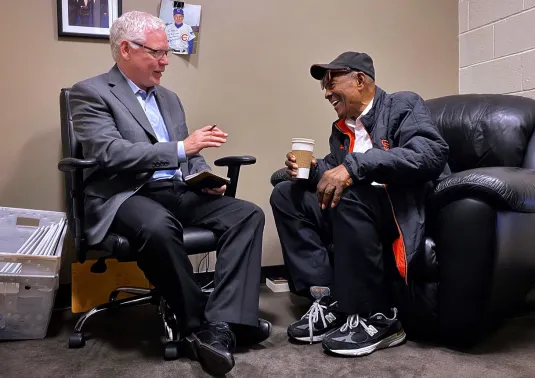
When I was collaborating with Giants clubhouse boss Mike Murphy on his autobiography, I was hanging out in “Murph’s” office one afternoon with him, Willie and Joe Torre, trying to comprehend my good fortune. Think of all the interviewing I could do! Mays, sitting next to me, sensed my overeagerness. “Let them talk,” Mays whispered, urging me to just let things happen. The all-time great as interview coach.

One interview I DID conduct was with Hall of Famer Billy Williams, who insisted that Mays, not San Francisco’s catcher, called pitches from center field in an effort to win a game and end a Giants slump. I brought this anecdote to Mays, who laughed uproariously before saying, “Naw, naw, naw, naw.” But his laugh said, “Sure. Of course. Yep.”

I should have retained Mays as my agent. Learning of my per diem allowance on the road which one organization allotted me, Mays squealed in his high-pitched voice, “Forty dollars? How are you supposed to survive on forty dollars?”

Yes, this was a saddening day, to say the least. But once we’ve dried the tears that were prompted by the innocence of youth, remember how much fun we had while loving Willie Mays for all these years. Hold onto those memories, and Willie will live onward.

WILLIE MAYS, SAN FRANCISCO GIANTS LEGEND AND MLB ALL-TIME GREAT, IS DEAD

By John Shea

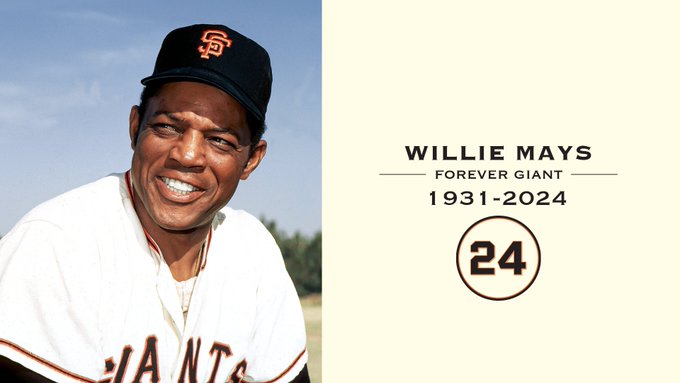
Willie Mays, the iconic and endearing “Say Hey Kid” who charmed countless fans with his brilliant athleticism and graceful style and was widely considered baseball’s greatest and most entertaining player, died Tuesday of heart failure. He was 93.

“My father has passed away peacefully and among loved ones,” said Mays’ son, Michael Mays. “I want to thank you all from the bottom of my broken heart for the unwavering love you have shown him over the years. You have been his life’s blood.”

The legendary slugger and center fielder was synonymous with the game of baseball, the Giants and San Francisco, where his 9-foot-tall bronze statue has greeted fans for more than two decades in front of Oracle Park at 24 Willie Mays Plaza. Mays was looking forward to Major League Baseball’s tribute to the Negro Leagues on Thursday at Rickwood Field in Birmingham, Ala., where he starred as a teenager with the Birmingham Black Barons.

“Today we have lost a true legend,” Giants chairman Greg Johnson said. “In the pantheon of baseball greats, Willie Mays’ combination of tremendous talent, keen intellect, showmanship, and boundless joy set him apart. A 24-time All-Star, the Say Hey Kid is the ultimate Forever Giant. He had a profound influence not only on the game of baseball, but on the fabric of America. He was an inspiration and a hero who will be forever remembered and deeply missed.”

Giants CEO Larry Baer added, “I fell in love with baseball because of Willie, plain and simple. My childhood was defined by going to Candlestick with my Dad, watching Willie patrol center field with grace and the ultimate athleticism. Over the past 30 years, working with Willie, and seeing firsthand his zest for life and unbridled passion for giving to young players and kids, has been one of the joys of my life.” 

Mays spent most of his 23-year playing career with the Giants, six in New York and 15 in San Francisco, making him a cherished superstar from coast to coast. He hit 660 home runs, made 24 All-Star appearances and won 12 Gold Gloves. He likely would have won more, but the award wasn’t given out until Mays’ sixth season.

The consummate five-tool player, Mays was elite at hitting, hitting for power, defending, throwing and baserunning, and his ability to outthink and outsmart the competition served as a valuable sixth tool.

Mays wowed the baseball world with his aggressive (sometimes unorthodox) swings, patented basket catches and daring speed. He’d wear his cap a size too small so that it would fly off when he took off in the outfield or on the bases, putting a charge into fans.

“No player is better defined by how he did it than what he did than Willie Mays,” said San Francisco-based actor Danny Glover at Mays’ 90th birthday bash at Oracle Park. As a youngster, Glover watched the center fielder play in the late 1950s at Seals Stadium.

A pioneer who broke down barriers on and off the field, Mays received the Presidential Medal of Freedom from President Barack Obama in 2015, a half-century after he was named the first African American team captain in MLB history.

Mays said he never could have envisioned a Black president in his lifetime. At the White House medal ceremony, Obama told the crowd, “It’s because of giants like Willie that someone like me could even think about running for president.”

Throughout his life, Mays helped countless people in many ways including through his Say Hey Foundation, which is dedicated to providing positive opportunities for underprivileged youth.

“I do what I can for people, man,” Mays said in a May 2021 Chronicle interview, shortly before his 90th birthday. “When the kids ask me for something, I give it to them. Let them have it because they’re going to be here after I’m gone, and I want the kids to enjoy what they can enjoy.”

Mays was born in Westfield, Ala., just outside Birmingham, to very young parents, Willie Howard Mays Sr. and Annie Satterwhite, and was raised largely by his mother’s sisters, Sarah and Ernestine. Willie Sr. wasn’t always around; he worked in a steel mill and as a Pullman porter and also made money playing ball.

Still, Mays called his father the biggest inspiration in his life. “Cat,” as his dad was nicknamed because of his quickness on the field, introduced Willie to baseball and played with him on an industrial league team.

“When I played with him, I played center, he played left,” Mays said. “I said, ‘You play on the line, I’ll take care of everything else.’ … We could talk about anything, which was good for me.”

Mays was an excellent quarterback at Fairfield Industrial High School and loved basketball, but his dad encouraged him to stick with baseball and helped connect him with Piper Davis, the player-manager of the legendary Black Barons of the Negro American League.

Mays spent parts of three high school years with the Black Barons and helped them reach the final Negro Leagues World Series in 1948. After graduating from high school in 1950, Mays signed with the Giants for $4,000 and a $250-a-month salary.

Then 19, Mays experienced a culture shock when moving from the Negro Leagues to the Trenton Giants of the previously all-white Class B Interstate League, hearing some of the racial taunts that had been directed at Jackie Robinson, who broke the color barrier three years earlier.

Mays opened the 1951 season at Triple-A Minneapolis and was hitting .477 in late May when promoted to the majors. Leo Durocher, who became Mays’ favorite manager, anticipated the young player providing energy to his scuffling team.

Mays began his Giants career batting 0-for-12 and 1-for-26, the only hit a homer off Hall of Famer Warren Spahn, but provided enough flashes of his all-around game to be named the National League’s top rookie, rebounding to finish the season with a .274 average and 20 home runs in 121 games. He was on deck when Bobby Thomson hit his famous pennant-winning home run, the “Shot Heard ’Round the World.”

Drafted during the Korean War, Mays played ball with the Army for nearly two years to entertain the troops, as did many big-leaguers of the day. He returned to the Giants in 1954 to win his first Most Valuable Player award and guide the Giants to a World Series championship.

In the eighth inning of Game 1 of that Series, the heavily favored Cleveland Indians had two runners on base when batter Vic Wertz slugged a ball nearly 460 feet to center field at the spacious Polo Grounds. Mays chased it down, reached over his shoulder and made what is considered the most famous catch in baseball history.

Mays always said it wasn’t his best catch, and argued that his throw afterward is what made the play. In one motion, he gloved the ball, whirled and heaved a strike to second base, assuring that runners Larry Doby and Al Rosen would not score.

“I knew I’d get it. It was high enough where I could catch it,” Mays said in a Chronicle interview leading to his 75th birthday. “That wasn’t the problem. The hardest thing was getting it back to the infield. I knew Larry would score if I didn’t get the ball back quickly. I scored lots of times from second base on a deep fly that was caught.”

The game remained tied, and the Giants won in the 10th inning on Dusty Rhodes’ pinch-hit homer, the first of four straight wins. Fortunately, Mays’ catch was captured on black and white film, a benefit for ensuing generations to admire his defensive brilliance.

In 2017, the World Series MVP award was named in Mays’ honor.

“Willie saved the game,” said Hall of Fame outfielder Monte Irvin, Mays’ mentor and first roommate with the Giants. “If the Indians won that first game, they might’ve been the ones to win four in a row.”

Mays played in New York at a glorious time in baseball history as he, Mickey Mantle of the Yankees and Duke Snider of the Dodgers were the subject of a great debate throughout the boroughs: Who was the best center fielder: Willie, Mickey or the Duke?

Mays, who said Mantle was the fastest and most powerful, wound up outlasting the two other legends and compiling far better career numbers. Both Mantle and Snider later acknowledged that Mays was the best.

Mays was offered unconditional love in New York. It was where he got his Say Hey Kid nickname — courtesy of a sportswriter who noticed Willie at first didn’t know everyone’s names and would just say “Hey” — and was seen in the streets of Harlem playing stickball with kids.

After the Giants arrived in San Francisco in 1958, however, it took a while for Mays to be fully accepted. Yankees legend Joe DiMaggio had been a city favorite as a local kid and San Francisco Seals star, and Mays suddenly was playing his position in his ballpark in his town. Some folks were slow to warm to Mays.

Off the field, Mays and his wife, Marghuerite, were rejected when trying to buy a house in the prestigious St. Francis Wood neighborhood, because they were Black. The Mayses eventually got the house, but two years later, someone threw a bottle with a racist note through their front window.

Mays later married Mae Louise Allen and moved to the Peninsula town of Atherton, where he spent the rest of his life.

On the West Coast, Mays cemented his legend as the greatest Giant and, in many minds, the greatest overall player in baseball history. Many of his top offensive accomplishments came after the team moved West; he won his second MVP award in 1965.

The list includes his 3,000th hit, his four home-run game in Milwaukee, and his 16th-inning walk-off homer off Spahn that gave Juan Marichal a 1-0 victory (regarded as the greatest game ever pitched). He also hit the game-winning homer against Houston that helped the Giants force a best-of-three games series against the rival Dodgers that led to San Francisco’s first World Series appearance. Mays hit .455 in the three games with two homers off Sandy Koufax.

In May 1972, with owner Horace Stoneham financially strapped, the Giants traded Mays to the New York Mets. In his final season, 1973, Mays returned to the Bay Area in the World Series against the Oakland Athletics, which the A’s won in seven games. His game-deciding single off pitcher Rollie Fingers in Game 2 was his final hit.

“I didn’t ever want to be traded,” Mays said. “You’re with a club so long, you don’t want to go anywhere. But when I got to New York, it was like I never left. All the players hugged me and asked where I’d been so many years.”

At the end of his career, Mays ranked third all-time in home runs behind Hank Aaron and Babe Ruth, with 660 (he now ranks sixth) and finished with a .302 average, 3,283 hits, 338 steals and 1,903 RBIs.

Mays would have had more homers if he hadn’t served nearly two years in his prime in the military. The rough elements at the Giants’ longtime home of windy Candlestick Park also might have been costly.

“I don’t like to look at it that way,” Mays said. “I like to look at it as, I had a good 20, 22 years. I had my time, and I enjoyed my time.”

Mays’ career numbers were recently changed slightly after Major League Baseball reclassified the Negro Leagues as a major league in 2020, so statistics through 1948 — Mays’ first year with Birmingham and the final year of the Negro League World Series — have been added to the register.

Aside from his talents as a player and entertainer, Mays was known for his durability. From 1951-61, he missed just 18 games (excluding his time in the military) and is the only player to appear in 150-plus games for 13 straight years.

Mays is third all-time in WAR — a stat that measures a player’s overall value — behind Ruth and Mays’ godson Barry Bonds, according to baseball site FanGraphs, and could have won many more MVPs if today’s advanced data had been applied. Mays led the National League in WAR 10 times and led the major leagues seven times.

Playing when All-Star Games were taken seriously by the players, Mays was an All-Star among All-Stars and played to win — the National League went 17-6-1 on his watch. Mays tripled home Hank Aaron to win in 1959, and the Chronicle’s Bob Stevens wrote, “Harvey Kuenn gave it an honest pursuit, but the only center fielder in baseball who could have caught it hit it.”

In 1979, Mays was elected to the National Baseball Hall of Fame by 94.7% of the electorate. In one of the stunning oversights in sports history, 23 voters chose to ignore Mays.

In another questionable decision, less than three months after Mays was inducted in Cooperstown, Commissioner Bowie Kuhn threw him out of the game for his association with a casino, Bally’s, even though Mays’ duties included little more than playing golf, appearing at charity events and signing autographs.

Kuhn similarly banned Mantle. Both actions seem ironic, considering how much today’s game associates itself with gambling outlets. One of Commissioner Peter Ueberroth’s first duties as Kuhn’s successor was to reinstate the two legends in 1985.

A year later, Mays returned to the Giants as a special assistant and ambassador, at first working with young players in spring training and, in later life, being available in the clubhouse to give advice and share stories.

John Shea is the San Francisco Chronicle’s national baseball writer. Email: jshea@sfchronicle.com Twitter: @JohnSheaHey

June 18, 2024

2.4.24 TO BE OFFICIALLY PROCLAIMED “WILLIE MAYS DAY”

SAN FRANCISCO, CA – San Francisco Mayor London Breed will officially proclaim this Sunday, February 4, 2024 as “Willie Mays Day,” in honor of baseball legend #24 Willie Mays. A once-in-a-century date, 2.4.24 has never and will never again be experienced during Mays’ lifetime. 

On 2.4.24, iconic San Francisco landmarks will be decorated in celebration of the “Say Hey Kid.” City Hall, the Ferry Building and Salesforce Tower will be dawned in orange and black lights, and Willie Mays Plaza – featuring the Willie Mays statue – and Oracle Park will also be illuminated in celebration of Mays. A special banner will hang from the 24 palm trees outside Oracle Park and the scoreboard will commemorate 2.4.24 throughout the day. Mayor Breed will be joined by Mays’ Godson Barry Bonds and Giants President and CEO Larry Baer in making the proclamation at San Francisco City Hall on the first day of Black History Month. The official proclamation will be shared publicly on 2.4.24.

As one of the best players in MLB history, Mays fostered unity, pride, identity and leadership. “Willie Mays Day” will celebrate the Hall of Famer’s impact as well as the grace, dignity and joy that he exudes. 2.4.24 will honor the example Mays sets as a hero and mentor, inspiring youth at the Hunters Point Boys and Girls Club that bears his name, through the Willie Mays Scholars program, the Say Hey Foundation and beyond. 

Willie Mays said, “I am honored by Mayor Breed’s proclamation, and would like to thank the City of San Francisco and the Giants for this day. The game of baseball has been great to me, and not only was I given the opportunity to play, but I was also given the opportunity to help kids all around the world. To me, this day means I am loved. This is as much my day as it is for everyone who loves the Game.”

Commissioner of Baseball Robert D. Manfred, Jr. said, “Our National Pastime always welcomes the opportunity to celebrate the game’s greatest living player, Willie Mays. Major League Baseball  applauds the San Francisco Giants and the City of San Francisco for honoring the best number 24 of all in grand fashion. To this day, Willie remains an inspiration to sports fans and baseball players everywhere. We look forward to highlighting Willie’s legacy at the MLB at Rickwood Field Game in his hometown of Birmingham this June 20th.” 

“To sports fans around the globe, Willie’s accomplishments and persona as the “Say Hey Kid” resonate every day,” said Larry Baer, President and CEO of the San Francisco Giants. “2.4.24 is one more opportunity to call attention to a man who, in our minds, is the greatest player ever. We are blessed to play our games at 24 Willie Mays Plaza with his image at our front door.” 

In a symbolic celebration of the Negro Leagues, and its greatest living player – Willie Mays – the San Francisco Giants will face off against the St. Louis Cardinals on June 20, 2024 at Rickwood Field. Rickwood Field, the oldest professional ballpark in the U.S., is the former home of the Birmingham Black Barons – the Negro League team Mays played for until the Giants signed him upon his graduation from high school in 1950. 

Named in honor of the Hall-of-Famer, the Giants Community Fund launched the Willie Mays Scholars program in 2021 to make college aspirations come true for Black youth in San Francisco. Five scholars are inducted annually and receive a scholarship of up to $20,000. To celebrate “Willie Mays Day,” the Willie Mays Scholars application is officially open for the 2024 season. Fans may join Willie Mays and the Giants in giving the gift of education via: giantscommunityfund.org/wms

Fans everywhere are encouraged to join the Giants in celebrating Willie Mays on 2.4.24. For more information, visit sfgiants.com/2424, and follow along with @SFGiants on InstagramTikTokYouTube and Facebook

SAN FRANCISCO, GIANTS TEAM UP TO HONOR WILLIE MAYS, NO. 24, ON 2/4/24

SAN FRANCISCO CHRONICLE-JOHN SHEA

Thanks to a mathematical marvel in the calendar, we get a chance to further celebrate Willie Mays. On Feb. 4, the stars — or superstars, in Mays’ case — will align for a once-in-a-lifetime phenomenon. Unless you’re 100 years old, that is. It will be Feb. 4, 2024, otherwise known as 2/4/24. Willie Mays Day, for all of those who will observe while realizing Mays’ number 24 is the most revered in the franchise history of the San Francisco Giants and one of the most revered in all of sports. Hoist a glass. High-five a buddy. Hug your kid. Honor baseball’s greatest overall player. Including at 2:24 p.m. Or if you dare, 2:24 a.m.

Many forces are collaborating to celebrate 2/4/24, in particular the mayor’s office and the Giants. City Hall will be lit up in orange and black, and 24 Willie Mays Plaza and the Oracle Park scoreboard will be dressed up accordingly. A proclamation by the city will be made to recognize 2/4/24 as Willie Mays Day, and the day will tie in with the Giants’ plans for Black History Month, including an announcement on the Willie Mays Scholars program. It will serve as their launch campaign for the Giants-Cardinals game on June 20 at historic Rickwood Field, where a teenaged Mays played in the Negro leagues as the center fielder of the legendary Birmingham Black Barons in Alabama.

Honoring the Say Hey Kid on 2/4/24 was the brainchild of Adam Swig, a friend of Mays who was struck by the calendar coincidence and began passing word that the momentous date was coming. Swig, founder and executive director of the California nonprofit Value Culture, contacted Giants CEO Larry Baer, who reached out to Mayor London Breed. Both showed immediate interest.

“Willie Mays made 24 cool,” said Swig, who rode with Mays through two of the Giants’ three World Series parades and solicited many local eateries that plan menu specials on Feb. 4 to acknowledge Mays. “He’s the greatest baseball player of all time, an American icon and American hero. And one of the greatest guys I ever met, a great friend. It’s pretty simple to me. It’s his day. He deserves it. San Francisco loves Willie Mays. I hope everyone puts on their 24 jerseys on 2/4/24.”

The Giants’ marketing and communications departments have gotten involved, as has the New York Giants Preservation Society, a group of longtime Giants fans whose mission is to “remember, treasure and preserve the storied history of the New York Baseball Giants.”From Jan. 31, through Feb. 5, the society will rename itself the Willie Mays Preservation Society. “This is the least we could do to show our support for Willie. We love him,” said society President Gary Mintz of Long Island, N.Y. “We want to stand with the Giants. It’s appropriate. They were nice to us when the (World Series) trophy tours came here. It’s a great way to honor someone who means so much to so many. Ninety-seven percent of our group are Giants fans. Why? Because of 24.”

Mays followers get the relevance of 24 and might include the number in their passwords, personal ID numbers or phone numbers. They insist Mays is the greatest ever, arguing that Babe Ruth, who played during segregation, didn’t have the five tools to the degree Mays did, and that two-way star Shohei Ohtani hasn’t done it long enough.

Mays began wearing No. 24 his rookie year in 1951, though it wasn’t his first number in the big leagues. That was 14, which he wore briefly after getting called up from Triple-A Minneapolis. He eventually wound up with 24, which had belonged to outfielder Jack Maguire before he was claimed by the Pirates. Maguire’s other footnote in history: He was credited with giving Lawrence Peter Berra the nickname Yogi.

Mays wore 24 longer than any other big-leaguer, 22 years. No. 2 on the list, at 20 years, are Tony Perez and Miguel Cabrera, who retired after last season. Dwight Evans wore it for 19 years, and both Rickey Henderson and Manny Ramirez wore it 17 years.

Rickey, who was raised in Oakland, wore 24 because of Willie. Ken Griffey Jr. wore 24 because of Rickey. Mays is the reason Golden State Warriors legend Rick Barry, who grew up rooting for him at the Polo Grounds, wore 24. When later playing in Houston, because Moses Malone already was wearing 24, Barry wore 2 in home games and 4 on the road.

While 24 is iconic from coast to coast — in 2022, five decades after Mays’ final game with the New York Mets, the team also retired his No. 24 — the number is especially relevant in San Francisco. Surrounding Mays’ 9-foot bronzed statue at 24 Willie Mays Plaza are 24 palm trees. The right-field brick wall is approximately 24 feet high. When Mays turned 85, he was honored when Muni cable car No. 24 was dedicated to him.

“To sports fans around the globe,” Baer said, “Willie’s accomplishments and persona as the Say Hey Kid resonates every day; 2/4/24 is one more opportunity to call attention to a man who, in our minds, is the greatest player ever. We are blessed to play our games at 24 Willie Mays Plaza with his image at our front door.”

The last 2/4/24 was Feb. 4, 1924, which was seven years before Mays was born and seven months before the birth of Bill Greason, Mays’ teammate on the 1948 Black Barons. Greason, 99, and Mays, 92, are the only living ballplayers who appeared in both MLB and the Negro leagues as far back as 1948, the year of the final Negro League World Series, which featured the Black Barons and Homestead Grays.

An American hero and inspiration three times over, Greason was the St. Louis Cardinals’ first African American pitcher, fought at the Battle of Iwo Jima and has served as a minister in Birmingham for more than a half century, still preaching. Mays and Greason remain good friends and in steady contact.

Speaking of the Black Barons, the Giants will give out 20,000 Mays bobbleheads depicting him as a Black Baron on May 31, which is African American Heritage Day. It’s a Friday night game against the New York Yankees, coming a few weeks after Mays’ 93rd birthday, May 6.

Mays is dealing with health issues including with his mobility following hip surgery in spring 2022. He still keeps up with Giants baseball, engages in lively conversation when visitors drop by and greets them with his patented firm handshake.

After Feb. 4, the next 2/4/24 isn’t until Feb. 4, 2124, so the upcoming 2/4/24 might as well be embraced to the fullest.

Reach John Shea: jshea@sfchronicle.com; Twitter: @JohnSheaHey